What is Compound Interest? (And Why It Matters)
Compound interest is the interest you earn on interest. It is the financial mechanism that transforms modest, consistent savings into significant long-term wealth. Unlike simple interest, which only calculates returns on your initial principal balance, compounding factors in your initial deposit plus all the accumulated returns from previous periods.
Albert Einstein famously called compound interest “the eighth wonder of the world. He who understands it, earns it… he who doesn’t, pays it.”
How Compounding Accelerates Your Wealth
When you first start investing, your returns might seem small. However, as your balance grows, the interest earned begins to outpace your personal contributions.
For example, if you invest $10,000 at an 8% annual return, you earn $800 in your first year. The next year, you earn 8% on $10,800 ($864). Fast forward 30 years, and that single initial investment grows to over $100,000 without you ever adding another dollar.
🧮 The Compound Interest Formula
Our free online calculator uses the monthly compounding formula (Annuity Due) to give you the most accurate projection possible for modern index funds, high-yield savings accounts (HYSAs), and retirement portfolios.
The underlying math operates on this algebraic equation:
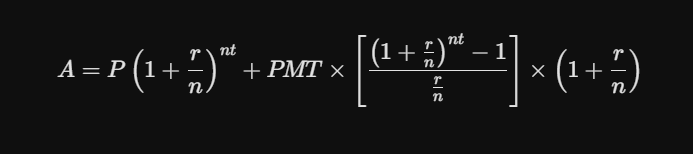
Key Variables Explained:
- A (Total Future Value): The final amount of money you will accumulate at the end of your timeframe.
- P (Principal): Your initial starting balance or investment size.
- r (Annual Interest Rate): The nominal interest yield, expressed as a decimal (e.g., 8% becomes 0.08).
- n (Compounding Frequency): How often interest is calculated per year. Our calculator uses 12 (monthly compounding) as it is standard practice for modern financial institutions.
- t (Time Horizon): The total number of years you plan to let your money grow.
- $PMT$ (Monthly Contribution): The periodic addition made to the account at the beginning of each month.
❓ Frequently Asked Questions (FAQ)
What is a good interest rate for long-term compound growth?
Historically, the S&P 500 stock market index has returned an average of roughly 10% per year before inflation. For conservative wealth projections, most financial planners recommend using a realistic rate between 6% and 8%.
What is the difference between daily and monthly compounding?
Daily compounding calculates your returns 365 times a year, while monthly compounding does it 12 times. While daily compounding earns you slightly more over long periods, the real-world dollar difference on a standard portfolio is minimal compared to the impact of increasing your monthly contributions.
How does inflation impact my compound interest projections?
Inflation reduces your purchasing power over time. To see your future portfolio value in terms of today’s buying power, subtract an average inflation rate (historially around 2.5% to 3%) from your estimated investment return rate before running the calculator.