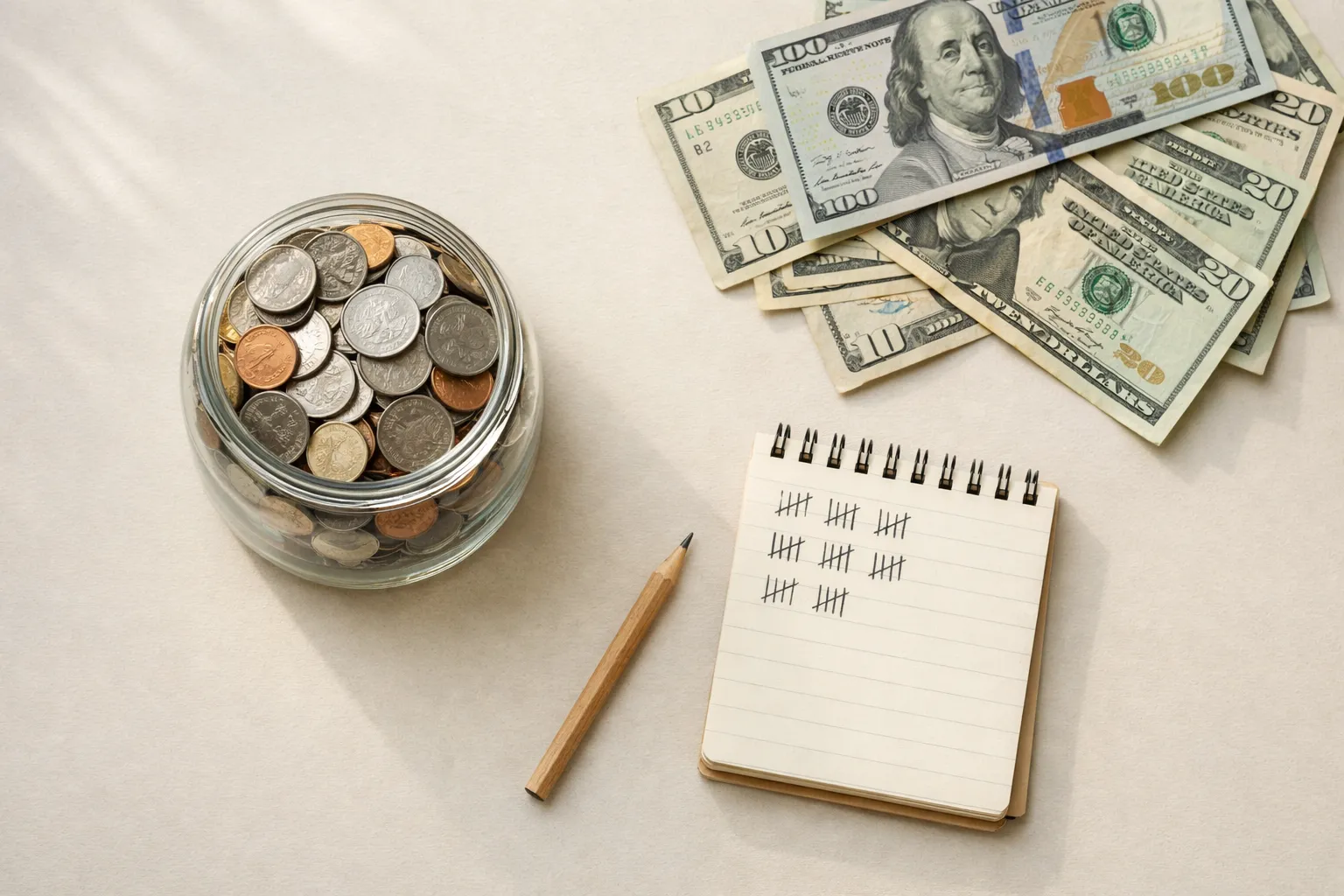
You check your bank balance, see two digits instead of three, and wonder if you’ll ever get ahead. You’re not broken. You’re not bad with money. The first $1,000 is genuinely the hardest money you’ll ever save.
Here’s why it feels rigged against you — and the small shifts that actually work.
Why Broke Feels Expensive
When you have zero cushion, your brain flips into survival mode. Psychologists call this a scarcity mindset. It’s not weakness — it’s biology.
Here’s the catch: that survival mode eats up mental energy. Researchers call it a “bandwidth tax.” Your brain gets so busy just getting through the week that long-term planning takes a back seat.
And being broke is expensive in real dollars, too. No cushion means a flat tire isn’t a minor annoyance — it’s a crisis. You can’t buy in bulk to save money. You eat late fees when a paycheck lands a day off schedule. Economists call this the scarcity trap. It actively fights your attempts to get ahead.
Your Brain Wants You to Spend
This isn’t just a bank balance problem. It’s an evolution problem.
For most of human history, grabbing resources right now was the smart move. There was no guarantee of food tomorrow, so waiting was risky. That instinct is still running the show, and it shows up as present bias — the pull toward a $50 dinner tonight over a bigger reward later.
There’s a second force working against you too. Saving can feel like losing. Every dollar you tuck away instead of spending registers in your brain as a small loss. And humans feel losses roughly twice as strongly as we feel equivalent gains. So saving doesn’t just feel hard — it feels like it hurts.
How to Actually Save It
You can’t out-willpower your own brain chemistry. But you can build systems that don’t require willpower at all.
Pay yourself first. Flip the usual order. Most people save whatever’s left after expenses — which is usually nothing. Instead, move money into savings the moment your paycheck lands, before you touch it for anything else.
Automate it completely. Set up an automatic transfer to a high-yield savings account on payday. If the money’s gone before you see it, there’s no monthly argument with yourself about whether to save it. You’ve removed the decision entirely.
Try the 52-week challenge. If $1,000 feels too big to picture, shrink it. Save $1 in week one, $2 in week two, and keep climbing by a dollar each week. By December, you’ll have saved close to $1,400 without ever facing a scary number.
Use zero-based budgeting. Give every dollar a job until income minus expenses equals zero. Nothing slips through the cracks, and nothing disappears on things you can’t remember buying.
Why the Next $10,000 Gets Easier
Something shifts once you cross that first $1,000 line. Psychologists call it self-efficacy — real proof, not a pep talk, that you’re someone who can actually save.
The math backs this up too. That first $1,000 is 100% your own grit, dollar by dollar. But once it’s there, the game changes. Small emergencies stop being financial disasters, so you make calmer decisions instead of panicked ones. And eventually your money starts pulling its own weight through compound growth — earning while you sleep instead of just sitting there.
The first $1,000 might take you the better part of a year of real effort. That’s normal. It’s also the last time saving will ever be this hard.
The takeaway: You’re not failing at saving. You’re fighting biology and bad math at the same time. Automate what you can, shrink the goal until it’s not scary, and know that the first $1,000 is the only one that requires this much grit. After that, the math starts working with you instead of against you.

Leave a Reply